
Access and Belonging
Pine Ridge Presbyterian Church
At Pine Ridge we have learned to say something more specific than “all are welcome.” We say: you are wanted. Not accommodated. Not tolerated. Wanted — because without you, we are not complete.
That conviction has a plain consequence for a building. A church that says you are wanted and then asks you to be carried up a step has not actually said it. Welcome that stops at the door is not welcome. So we have worked, and are still working, to make this a place where you can arrive, move through, participate, and lead — without having to ask permission, wait for help, or explain yourself.
We do this by choice. Houses of worship were largely exempted when the Americans with Disabilities Act was written, which means most of what follows is not legally required of us. We are not meeting a minimum. We are trying to be the church. Our own Book of Order guarantees every person “full participation and representation” in the church’s worship, governance, and emerging life, and it names disability alongside race and gender in doing so. The Presbyterian Church (U.S.A.) has taught for two decades that the full inclusion of people with disabilities requires “compassion and the establishment of a just social reality.” We take that as a description of work to be done, not a sentiment to be admired.
And underneath all of it: we love because God first loved us. Grace comes first. Whatever welcome we manage here is a response to a love we did not earn and cannot exhaust — a love given to people who bear the image of God, which is to say, everyone.
If something on this page doesn’t match your experience of our building, or if you need something we haven’t thought of, please tell us: information@pineridge.org.
What This Means When You Arrive
Parking. Accessible parking is available at every entrance to our campus — the West Sanctuary lot, the North Main lot, the East staff doors, and the East courtyard circle. Each entrance has at least two accessible spaces, and some have as many as six. Several are van-accessible.
Entrances and moving through the building. Every public and staff entrance is step-free. Inside the main building, an elevator serves both the main and lower levels, which means there is no-step access to every space in the main building.
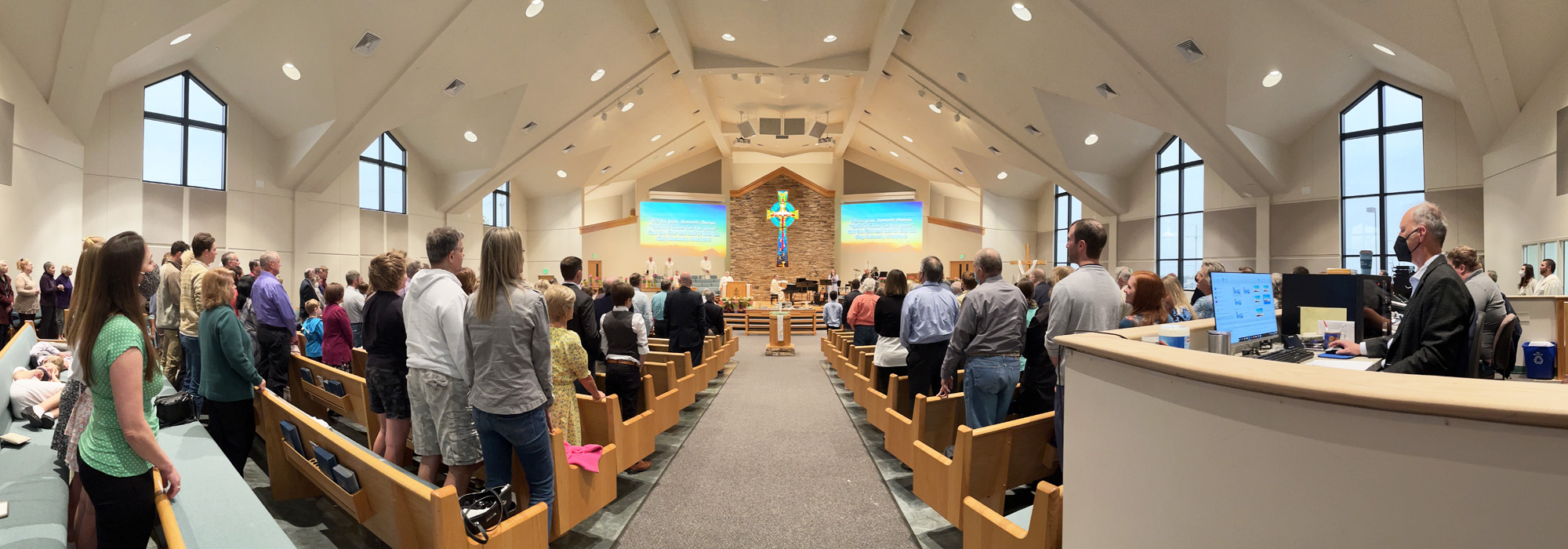
Seating in the Sanctuary. There is space for wheelchairs at the front of the Sanctuary, at the back, and at several points along the side aisles at varying distances from the chancel. Each includes room for companion seating. This was deliberate. If you use a wheelchair at Pine Ridge, you are not seated at the back because the back is the only place you fit. You choose where you sit, like everyone else.
Restrooms. The main foyer restrooms are accessible and open with push-button doors. We also have three all-gender, single-stall, family-style restrooms — two beside Holy Grounds and one beside Still Waters — and the two beside Holy Grounds each have a bench inside. There are accessible restrooms on the lower level as well, though these are outfitted primarily for our Preschool. Changing tables are available in several locations. We do not currently have an adult changing table.
Hearing assistance. We have four FM assistive listening receivers available for worship and other Sanctuary events. Pick one up from an usher at the table just outside the main Sanctuary doors, across from the Welcome Center. Headphones are provided, and you are welcome to use your own instead. Each unit includes an integrated neckloop for use with T-coil-equipped hearing aids.
Still Waters. Our sensory-friendly worship space is open to all ages, with adjustable volume and lighting and full visibility into the Sanctuary. It is available at every service and at all Sanctuary events. Still Waters is selfserve; we ask that a parent or guardian remain with children under 18. It is not a separate service. It is a different way of being present in the same one.
Communion. We offer a gluten-free station, and you may receive by intinction or by individual cup of grape juice. A server brings the elements to anyone who cannot come forward, or would rather not.
Genesis House. Our historic farmhouse — the original meeting house of this congregation — has step-free access to the side porch and to both main meeting rooms. Because of the building’s age and historic character, there are steps to the kitchen, the restrooms, and the small classroom. There is no elevator; the house is a single level. We name this plainly so that no one arrives expecting otherwise. If a gathering in Genesis House would be difficult for you to attend, let us know and we will do our best to relocate it.
Access to Leading, Not Only Attending
It is possible for a church to make its pews reachable and its pulpit unreachable. That arrangement quietly says that some people may attend but not lead. We have tried not to build that in.
A ramp behind the chancel, near the choir room, provides step-free access to the entire chancel — the pulpit, the platform, and the choir area, which also has a floor-level front row. The communion table and the baptismal font are already at floor level. In practical terms: a person who uses a wheelchair can preach from this pulpit, sing in this choir, and serve at this table.
Buildings are only part of it. Some of our liturgists find it difficult to stand on the open Sanctuary floor with nothing to hold onto, so when they lead worship, they stand behind the communion table instead. No announcement is made. It simply happens that way. That is the other half of accessibility, and no renovation produces it — the willingness to change how a thing is done so that a particular person can do it.
We want every person to be wanted here in participation and in leadership both. Where our practices need to bend so that someone can serve, we intend to bend them.
What We Are Still Working On
Every building has gaps, and a statement that claims none is not worth reading. Here are ours as we currently understand them.
Our main exterior entrances do not yet have push-button power doors. Our hearing assistance system still requires picking up a physical receiver; we would like to move to a system accessible directly from a smartphone. We do not have large-print hymnals, though a proposal to add them is under consideration. Captions on our livestream are currently auto-generated and available only on our Facebook stream, not our Zoom option. And we are working to formalize our procedures around food allergies rather than handling them case by case.
We would rather tell you these things than have you discover them.
Mental Health, Memory, and Disabilities That Aren’t Visible
Much of what gets called accessibility is really about wheelchairs and hearing aids. The people we most often fail are the ones whose barriers no one can see.
We are attentive to mental and emotional health, to living with dementia, and to the range of disabilities that leave no visible trace, as genuine questions of access rather than only of pastoral care. We do not have this figured out. We do not have a complete set of practices to point to. What we have is awareness, a willingness to learn, and a commitment to keep working — and we would rather say that honestly than imply a competence we have not yet earned.
Tell Us What We’ve Missed
We are certain there are barriers here we have not noticed, because the people who notice them are the people who encounter them.
If you find a barrier at Pine Ridge — physical, practical, or in how we do things — please tell us at information@pineridge.org. Questions, concerns, and suggestions are all welcome, and there is no need to justify the request. We would rather hear from you than have you quietly decide this isn’t a place for you.
If it would help to know something before you come — whether a space will work for you, whether an accommodation is possible — please ask. For some people that answer is what makes attending possible in the first place.
Ongoing Work
Responsibility for accessibility at Pine Ridge rests with our Church Health and Administration Ministry Area, which will maintain this work as an ongoing commitment rather than a completed project.
This is not a finished document. It will change as our building changes, as our practices change, and as people tell us what we have missed.
Adopted by the Session of Pine Ridge Presbyterian Church, August 18, 2026.